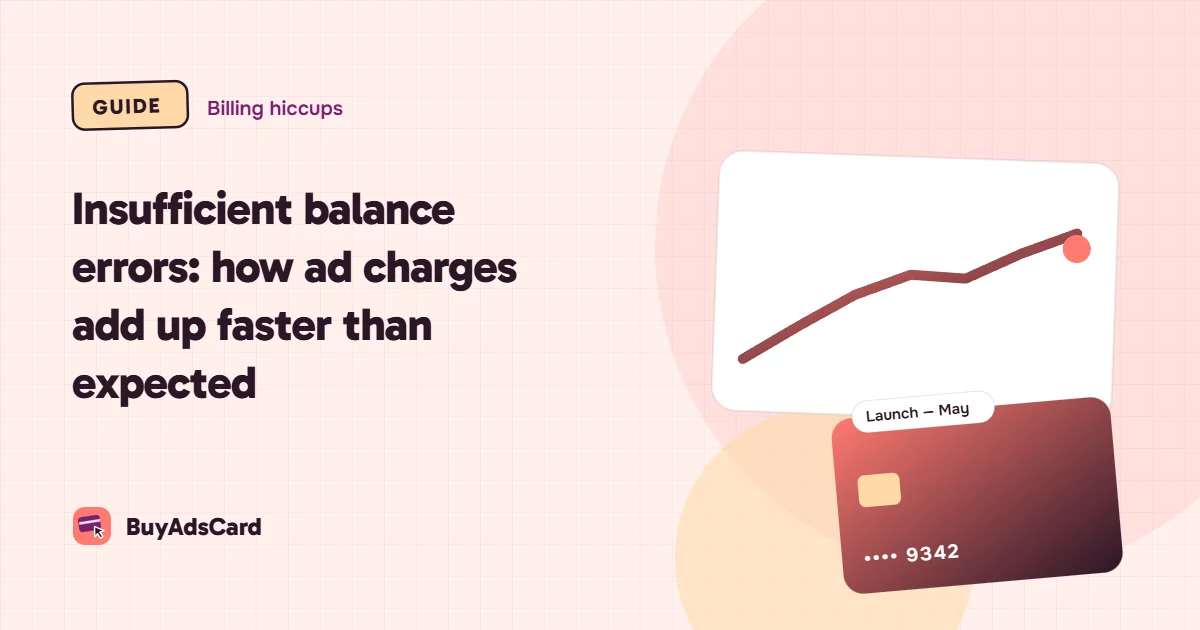
Insufficient balance errors: how ad charges add up faster than expected
"Insufficient funds" is the most common decline on fixed-balance ad cards, and it often surprises people who planned carefully. Here's where the extra charges come from and how to stop them catching you out.
Jump to a section
You did the maths. The campaign's budget, multiplied by the days in the month, fits on the card with room to spare. And yet, a week before month-end, the ad account reports a declined payment for insufficient funds. Where did the money go?
Insufficient balance is the most common reason an ad card with a fixed balance is declined — and usually not because anyone planned badly. Ad charges have several ways of arriving earlier, larger or more often than a simple budget calculation suggests. This guide walks through them, then covers recovery and prevention.
Where the "extra" money goes
Spending above the daily figure on busy days
Daily budgets are averages. Platforms routinely spend more than the daily figure on days with more opportunity, balancing it out on quieter days. Across a month the total matches the plan; on any given day it doesn't — and the card has to absorb the busy days.
Charges that arrive in big pieces
On accounts billed at thresholds, a charge can be as large as the threshold. If the threshold has quietly risen since the account was opened, individual charges get bigger too. A card holding enough for "the rest of the month" can still fail when a single threshold-sized charge exceeds what's left.
Two charges close together
A busy day can cross a threshold twice, or a threshold charge can land on the same day as a scheduled billing-date charge. Two charges in quick succession drain a balance faster than either alone.
Temporary holds
Some charges start as authorizations that reserve money before the final amount settles. The verification hold placed when a card is first added works the same way. For a while, part of the balance is reserved even though it hasn't been spent.
Currency conversion
When the ad account bills in a different currency from the card, each charge is converted at the rate of the moment, possibly with a margin. Over a month, small upward differences add up — enough to tip the last charge over the edge.
Another campaign using the same card
The most avoidable cause: someone added the same card to a second ad account, or a new campaign started in the same account without anyone adjusting the card's balance.
Recovering from an insufficient balance decline
- Check the card's remaining balance in your workspace and compare it with the failed charge.
- Look for overlapping charges or holds in the ad account's billing history.
- Decide how to cover the gap. Virtual cards with us can't be topped up, so the usual fix is a new card sized for the remainder of the period.
- Add the new card and make it the primary payment method. Use the holder name and billing address shown with it.
- Settle the outstanding amount if the platform shows one, then confirm ads are running again.
While a new card is being reviewed and issued, campaigns on that account may stay paused. That's why prevention matters more than the fix — the general approach to declines is in the launch-day decline checklist, and our how it works page shows how long a new card takes.
Preventing it next time
Size cards with headroom built in
Sizing a card as planned spend plus pacing headroom, billing headroom and a currency margin exists precisely because of the causes above; the fee math cheat sheet shows how that cushion changes the total.
Know the threshold, and lower it if you can
Check the account's current billing threshold. If the platform lets you lower it, smaller and more frequent charges are easier for a virtual card to absorb near the end of a period. How daily budget pacing works explains why busy days trigger threshold charges sooner.
Order the next card early
Set a trigger: when the remaining balance falls below a certain level — for example, around one week of expected spend plus one threshold — order the next card. That leaves time for payment and review before the current card runs out.
One card, one account
Keep each card on a single ad account, and ideally a single client or campaign. If someone wants to start a new campaign, the budget conversation should include which card pays for it.
Watch for budget edits
A raised daily budget or an extended lifetime campaign changes the arithmetic immediately. Make "check the card" part of every budget change.
A quick prevention checklist
- Card sized with all four kinds of headroom.
- Threshold known and, where possible, kept low.
- Reorder point set and noted in your calendar.
- Card used on one account only.
- Budget changes trigger a balance check.
Reading the billing history like a detective
When a decline happens, the ad account's billing history usually holds the explanation. Look for three things around the time of the failure: charges that landed within a day of each other, a charge noticeably larger than earlier ones (a sign the threshold went up), and any authorizations that were later released. Line them up against the card's balance on the same days. In most cases the pattern is obvious once it's written down in order — and it tells you which kind of headroom to add next time.
Frequently asked questions
Will the platform retry the charge automatically?
Many platforms retry failed charges after a while, and some pause delivery until a working payment method is added. Check the billing page for the account's current state rather than waiting.
The balance looked high enough. Why did it fail?
Look for a pending hold or two charges arriving together. The amount available can be lower than the balance you saw for a short time.
Should I load every card with a huge buffer to be safe?
A reasonable buffer is enough. Huge buffers tie up money unnecessarily; a reorder point gives the same safety with less idle balance.
Bottom line
Insufficient balance declines come from busy days, large threshold charges, overlapping charges, holds, conversion and shared cards — not from bad arithmetic. Build headroom for each, keep thresholds low where you can, reorder before the card runs dry and keep one card per account. Do that and "insufficient funds" becomes a rare message instead of a monthly one.
Give this budget its own card
Load exactly what the campaign should spend, label the card, and keep it apart from everything else.
Get started